

Psychometric Testing in Schools: What It Tells You About Career Fit
A psychometric test career guidance school uses structured aptitude, personality and interest assessments, not guesswork, to tell a family whether a child fits a defence, medical, engineering or commerce path. At Cardinal Warriors in Nimora, Raipur, these results feed directly into subject choices and coaching tracks well before Class 11 lock-in.
Key Takeaways
- Three test types matter: aptitude (numerical, verbal, spatial reasoning), personality (leadership, resilience, teamwork), and interest inventories that map to career streams.
- Timing window: Class 8 to Class 10 is the ideal age band for a first psychometric test, with a repeat assessment before Class 11 subject selection.
- Follow-through is the real test of quality: a school should convert scores into a specific, reasoned stream recommendation, not hand over a printout and move on.
- Defence-track families have two dates to plan around: the NDA 2 2026 written exam on 13 September 2026, and the AISSEE 2027 notification expected between September and October 2026.
- A low score in one area does not close a door. It tells you where extra coaching or a different subject combination will help.
At a Glance: Psychometric Testing in Career Guidance
| Factor | Detail |
|---|---|
| What is measured | Aptitude, personality traits, interest patterns |
| Ideal age to test first | Class 8-10 (age 13-16) |
| Ideal age to retest | Before Class 11 stream selection |
| Who interprets results | Trained counselor, ideally with retired military or subject-expert input |
| Streams typically mapped | Defence (NDA/AISSEE/RIMC), Medical (NEET), Engineering (JEE), Commerce (CA) |
| Defence exam date to plan around | NDA 2 2026 written exam: 13 September 2026 |
| Sainik School notification window | AISSEE 2027: expected September-October 2026 |
| Red flag | One-time test with no follow-up conversation or plan |
What Is a Psychometric Test, and Why Does a School Use One?
A psychometric test is not another academic exam. It does not check what a child has memorised; it checks how a child thinks, reacts, and prefers to solve problems. A maths test tells you if a student can solve equations. A psychometric test tells you whether that student enjoys structured logical work or would rather lead a group discussion.
Schools use these tools because marks alone hide a lot. Two students scoring 85% in Class 9 can have completely different natural strengths: one might have strong spatial reasoning suited to engineering, the other might show verbal fluency and persuasive ability suited to law or leadership roles. A test surfaces that difference early.
At Cardinal Warriors, psychometric testing sits inside the broader military education, tactical training, academic learning and sports framework, alongside personalised career counseling sessions where results are discussed, not just filed. That combination matters more than the test itself.
How Is This Different From an SSB Assessment?
An SSB assessment evaluates a young adult’s readiness for a defence commission through group tasks, interviews and psychology tests over five days. A school psychometric test happens years earlier, measures broader career fit, and is diagnostic rather than a pass-fail screening.
Both use overlapping psychological principles, though. A student who has already taken a school-level psychometric test and understands their own reasoning style walks into an SSB-style evaluation with a real advantage: self-awareness that reduces nervous, inconsistent answers.
What These Tests Actually Measure
Most school-administered psychometric batteries fall into three buckets. Understanding them helps a parent read the report intelligently instead of just checking a final score.
- Aptitude tests: numerical reasoning, verbal reasoning, spatial visualisation, and mechanical comprehension. These predict which subjects a student will find genuinely easier to master, not just pass.
- Personality inventories: traits like leadership tendency, emotional stability under pressure, teamwork orientation, and decision-making speed. These map closely to what a defence services board looks for.
- Interest inventories: a structured questionnaire that ranks a student’s preference across fields like science, social service, mechanical work, arts, and commerce. This is where “I want to join the army” gets checked against actual preference patterns, not just family expectation.
A well-designed report combines all three. A student might show strong numerical aptitude and high interest in science, but a personality profile that leans toward independent, solitary work rather than team command. That combination points toward a specialist technical role over a general command track, and a good counselor will say so directly.
How Psychometric Results Connect to Career Guidance in a Military School
A military school has an obligation most regular schools don’t carry: many families arrive already assuming their child will join the armed forces, sometimes before anyone has checked whether that fits the child’s actual aptitude and temperament.
Psychometric testing at a school like Cardinal Warriors exists partly to have that honest conversation early. A student with strong analytical aptitude and lower group-leadership scores might be better suited to a technical defence branch, or to NEET or JEE preparation, rather than a general infantry command path.

The school’s retired military personnel bring something a generic counseling centre cannot: direct, first-hand knowledge of what an SSB board actually screens for. When they read a psychometric report alongside a student’s performance in tactical training drills, the resulting guidance is grounded in real service experience, not a textbook interpretation.
This is also where the school’s SSB interview coaching track connects back to the psychometric report. A counselor who has already flagged low resilience-under-pressure scores can build a coaching plan that works on exactly that gap, months before a real SSB board ever sees the student.
When Should a Child Take a Psychometric Test?
Class 8 to Class 10 is the ideal window for a first psychometric test, because a child’s reasoning patterns are stable enough to measure but subjects have not yet been locked in for board exams. A second test before Class 11 refines the picture right when stream choice becomes final.
For families targeting a defence career specifically, timing also has to account for exam calendars. The NDA 2 2026 written exam falls on 13 September 2026, which means a Class 12 aspirant needs their subject and coaching decisions settled at least a year earlier. Younger families eyeing Sainik School entry should watch for the AISSEE 2027 notification, expected between September and October 2026, and use the months before that window to complete a first round of psychometric evaluation.
How to Choose a School That Does Psychometric Testing Right
Not every school that offers a psychometric test does it well. Some hand students a generic online quiz borrowed from a corporate HR vendor and call it career guidance. A parent evaluating schools in Raipur should ask pointed questions before accepting the label at face value.
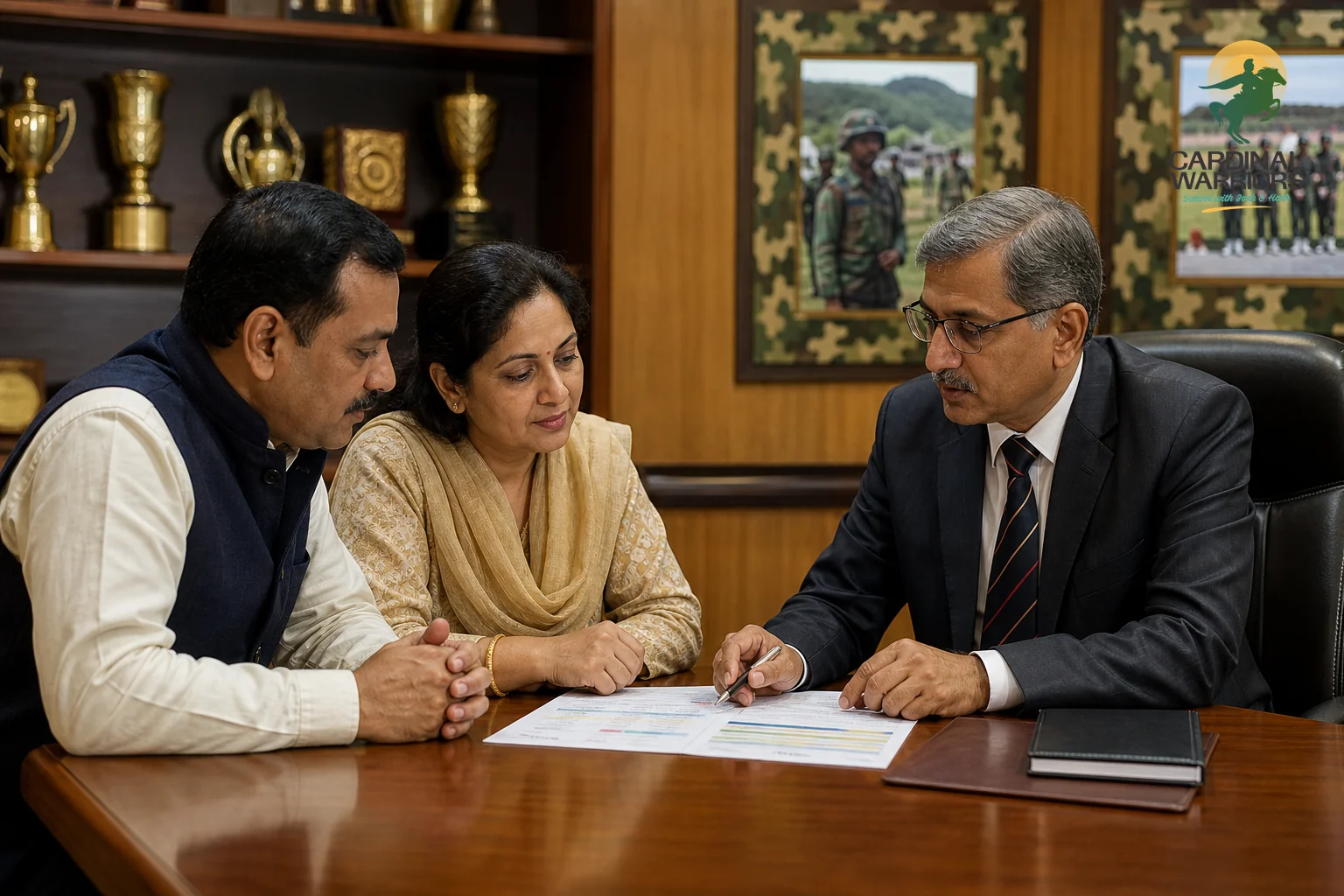
- Who administers and interprets the test? A trained counselor or psychologist should read the results, not a class teacher filling a form.
- Is there a one-on-one follow-up session? Parents should sit down and hear the reasoning behind a recommendation, not just receive a percentile chart.
- Does the school connect results to its own coaching tracks? A report that says “strong analytical aptitude” is only useful if the school then offers a concrete next step, such as NEET, JEE, or NDA-focused coaching.
- Is the test repeated over the years? A single test in Class 9 that is never revisited misses how a child’s interests shift by Class 11.
- Red flag: a school that markets psychometric testing prominently in its prospectus but cannot describe, when asked directly, what happens after the report is generated.
This same due-diligence habit applies broadly when comparing institutions. Parents weighing a private military school against a government-run option should read our guide on red flags to avoid when choosing a military school for a wider checklist beyond testing alone.
What to Look For in the Follow-Up Conversation
A useful follow-up session gives a specific stream recommendation with clear reasoning, connects that recommendation to an actual coaching plan, and leaves time for parents to ask questions before subjects are locked for Class 11. Anything vaguer than that is not real guidance.
Ask the counselor to walk through one concrete example: if the report shows high spatial reasoning and moderate leadership scores, what does the school suggest, and why? A specific, reasoned answer signals a school that treats this seriously. A shrug or a generic “we’ll monitor” answer signals the opposite.
Psychometric Testing and Defence Career Aspirants in Raipur and Nimora
Chhattisgarh has a strong tradition of families sending children toward defence careers, and Raipur and Nimora specifically have seen growing demand for schools that combine CBSE academics with structured military preparation. That demand sometimes runs ahead of the evaluation step.
A family in Nimora considering the NDA route for their son or daughter benefits from testing before committing years of coaching effort toward a single goal. If the psychometric profile instead points toward structured leadership development combined with a technical stream, that is worth knowing in Class 9, not after a rejected SSB attempt in Class 12.
Cardinal Warriors runs its psychometric assessments alongside SSB-style group tasks, tactical drills and academic performance tracking, so a student’s file reflects more than one test taken on one morning. That layered picture is what makes a recommendation credible rather than mechanical.
Frequently Asked Questions
Is psychometric testing compulsory in CBSE schools?
No, CBSE does not mandate psychometric testing as part of its curriculum. It is offered at the discretion of individual schools, often as part of career counseling, and quality varies widely between institutions.
Can a test really predict if a child suits NDA or SSB?
A psychometric test predicts general reasoning style and personality traits relevant to defence roles, such as decision-making under pressure and leadership orientation, but it does not replace an actual SSB board’s five-day evaluation. It is a useful early indicator, not a guarantee.
What age is the test most accurate?
Results are most reliable from age 13 onward, once a child’s cognitive patterns have stabilised enough to measure consistently. Testing much younger tends to capture mood or maturity level rather than lasting traits.
Does a low aptitude score rule out a stream?
No. A lower score in one area points to where extra coaching or a different subject combination will help, not to a closed door. Interest and effort can shift outcomes considerably when a school builds a plan around the gap instead of ignoring it.
For families comparing this school-integrated approach against a Sainik School or Rashtriya Military School path, our detailed comparison on Sainik School Class 6 or Class 9 entry covers the timing questions that often come up alongside career testing.
Making the Right Call for Your Child
A psychometric report is only as useful as the conversation that follows it. Parents in Raipur and Nimora evaluating Cardinal Warriors, or any school promising career guidance, should ask to see how a test result actually changes a student’s coaching plan, not just their file.
To see how Cardinal Warriors combines psychometric evaluation with its NDA, AISSEE, NEET and JEE coaching tracks, read more about our approach or explore our career guidance framework in detail. For a direct conversation about where your child’s results might lead, contact us to schedule a counseling session ahead of the AISSEE 2027 notification window and the NDA 2 2026 exam cycle. You can also follow updates on Facebook and Instagram.

You may also like

What Changes When a School Is Run by an Army Veteran

Homesickness in Boarding School: An Honest Look at Month One