NDA Physical Fitness Standards: The Numbers Your Child Must Hit
The NDA physical fitness standards come down to specific numbers a board checks against, not a vague sense of “being fit”: minimum height between 157 cm and 162.5 cm depending on service wing, a chest expansion of at least 5 cm, corrected vision within set limits, and a set of SSB obstacle tasks a candidate must complete under a stopwatch. Miss any one number and the file stops moving, regardless of how well the child scored in Maths and GAT.
Key Takeaways
- Two separate checks: a medical board measures height, weight, chest and vision; the SSB tests running, climbing and group obstacle tasks over five days.
- Height minimum: around 157 cm for Army/Navy entries and 162.5 cm for Air Force, with a few cm of relaxation for candidates from hill regions, not applicable to most Chhattisgarh applicants.
- Chest expansion: a minimum expansion of 5 cm between normal and expanded chest measurement is checked at the medical board, alongside proportional weight-for-height.
- Timeline matters: vision and dental corrections done by Class 9-10 avoid last-minute medical board rejection before the NDA 2 2026 written exam on 13 September 2026.
- Fitness is built, not crammed: a 2.4 km run under an academy-grade time needs 12-18 months of progressive training, not six weeks before SSB.
NDA Physical Fitness Standards at a Glance
| Check | Where It’s Tested | Typical Requirement | Best Time to Fix It |
|---|---|---|---|
| Height | Medical Board | 157 cm (Army/Navy), 162.5 cm (Air Force), minor relaxation for hill/NE candidates | Monitor from Class 8 onward; nutrition and growth tracking |
| Chest expansion | Medical Board | Minimum 5 cm expansion between normal and full breath | Daily PT and swimming from Class 6-7 |
| Weight-for-height | Medical Board | Proportional range on standard charts, not underweight or overweight | Balanced diet plus supervised training, monitored yearly |
| Vision | Medical Board | Correctable defects allowed within limits; certain conditions disqualify | Eye check by Class 9, correct early if spectacles needed |
| 2.4 km run | SSB physical routine | Academy-grade pace, improved through structured training | Start base running by Class 8, build pace through Class 11-12 |
| Group Obstacle Race / individual obstacles | SSB Day 3-4 (GTO tasks) | Nine obstacles including six-foot wall, tarzan swing, and more, completed within a team time limit | Simulate on a school obstacle course from Class 9 onward |
| Written exam readiness | UPSC NDA written paper | Maths (300) + GAT (600) cleared before physical/medical stage begins | NDA 2 2026 written exam is on 13 September 2026 |
The written exam has to be cleared before a candidate ever faces a medical board or an SSB obstacle course. But treating physical readiness as something to start after results arrive is exactly where most families in Raipur and Nimora lose time they cannot get back. The NDA eligibility 2026 age, class 12 subjects and physical standards criteria set the boundary conditions; this piece unpacks the physical numbers inside that boundary.
1. Know the Two Different Fitness Checks the NDA Runs
Parents often assume “physical fitness standards” means one test on one day. It’s actually two separate systems run by two separate boards. The medical board checks static numbers: height, weight, chest expansion, vision, hearing, dental health and general physical condition against a fixed table. The SSB checks dynamic performance: how a candidate runs, climbs, jumps and works as part of a team under time pressure, spread across the Group Testing Officer tasks on Days 3 and 4 of the interview.
A child can clear one and fail the other. Strong obstacle-course performance doesn’t offset a chest expansion below the minimum, and perfect height-weight numbers won’t carry a candidate through a six-foot wall if their legs haven’t practiced the movement. Families researching what disqualifies candidates should read NDA medical standards: the most common reasons candidates are rejected alongside this article, since the two checks fail for very different reasons.
2. Hit the Minimum Height and Chest Numbers First
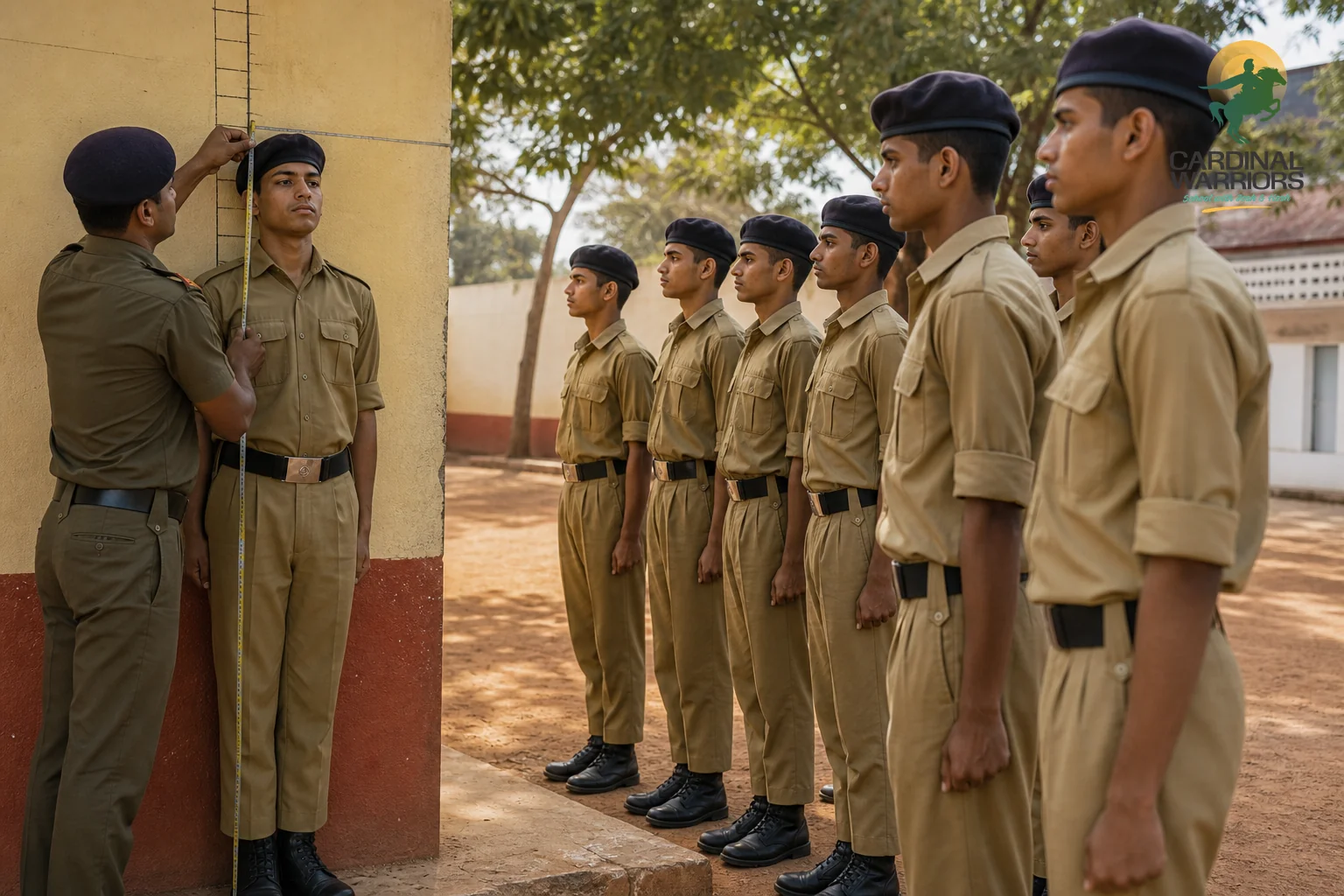
Height minimums differ by wing. Army and Navy entries generally require around 157 cm, while Air Force entries need closer to 162.5 cm because of cockpit and ejection-seat safety margins. A short relaxation applies to candidates from specified hill states and the northeast, which rarely applies to applicants from Chhattisgarh, so families here should plan against the standard figure rather than hope for a waiver.
Chest expansion is measured as the difference between a normal, relaxed chest measurement and the same measurement after a full, deep breath. The board looks for at least 5 cm of expansion, which reflects lung capacity and rib-cage flexibility built over years of running, swimming and breathing drills, not something achievable in a crash session two weeks before a medical exam.
Weight is checked against height on a proportional chart, not a flat number. A candidate significantly underweight or overweight for their height gets flagged even if height and chest pass individually. This is where diet, sleep and a consistent daily training block matter more than any single week of dieting.
This is also where regional growth patterns matter. Children in Raipur and across Chhattisgarh sometimes hit growth spurts later than the national average tables assume, which is exactly why a school tracking height and chest measurement every term, rather than once before the exam, catches a shortfall early enough to plan around it.
3. Train for the SSB Physical Tasks, Not Just a Fitness Test
The SSB doesn’t run a standalone fitness test with a scoreboard. It embeds physical performance inside the Group Testing Officer tasks: the Group Obstacle Race, individual obstacles, the command task, and the half-group tasks that ask candidates to move ropes, planks and drums across a marked area as a team. Nine individual obstacles typically make up the course, including a six-foot wall, a tarzan swing across a gap, and a balancing beam, each attempted under the group’s collective time pressure.
What the board is actually watching isn’t raw speed. It’s whether a candidate keeps trying an obstacle after failing once, whether they help a struggling teammate instead of running ahead, and whether fatigue changes their attitude. A child who has practiced obstacle movement patterns dozens of times reacts to a missed attempt calmly. A child seeing a six-foot wall for the first time on interview day reacts with visible panic, and assessors notice that difference immediately.
Read the full breakdown of what happens across all five SSB days in the SSB five-day process, day by day: screening to conference, since the GTO tasks covered here sit inside Days 3 and 4 of that sequence.
4. Build the Running Numbers Early: 2.4 km and Beyond
Service training academies run candidates through a 2.4 km timed run as part of induction fitness testing, and while the exact pass mark used for NDA aspirants isn’t published as a single fixed figure, the direction is unambiguous: pace and stamina matter more than a single fast sprint. A candidate who can hold a steady pace for 2.4 km without stopping is in a completely different fitness bracket than one who can only manage 400 metres before slowing.
A workable progression for a 13-to-17-year-old looks like this:
- Months 1-3: alternate walking and jogging to build a comfortable 1.5 km base without stopping.
- Months 4-8: extend to a continuous 2.4 km jog, focused on finishing, not speed.
- Months 9-14: add interval sprints twice a week to bring the 2.4 km time down steadily.
- Months 15 onward: combine running with obstacle-specific strength work like pull-ups, rope climbs and wall vaults.
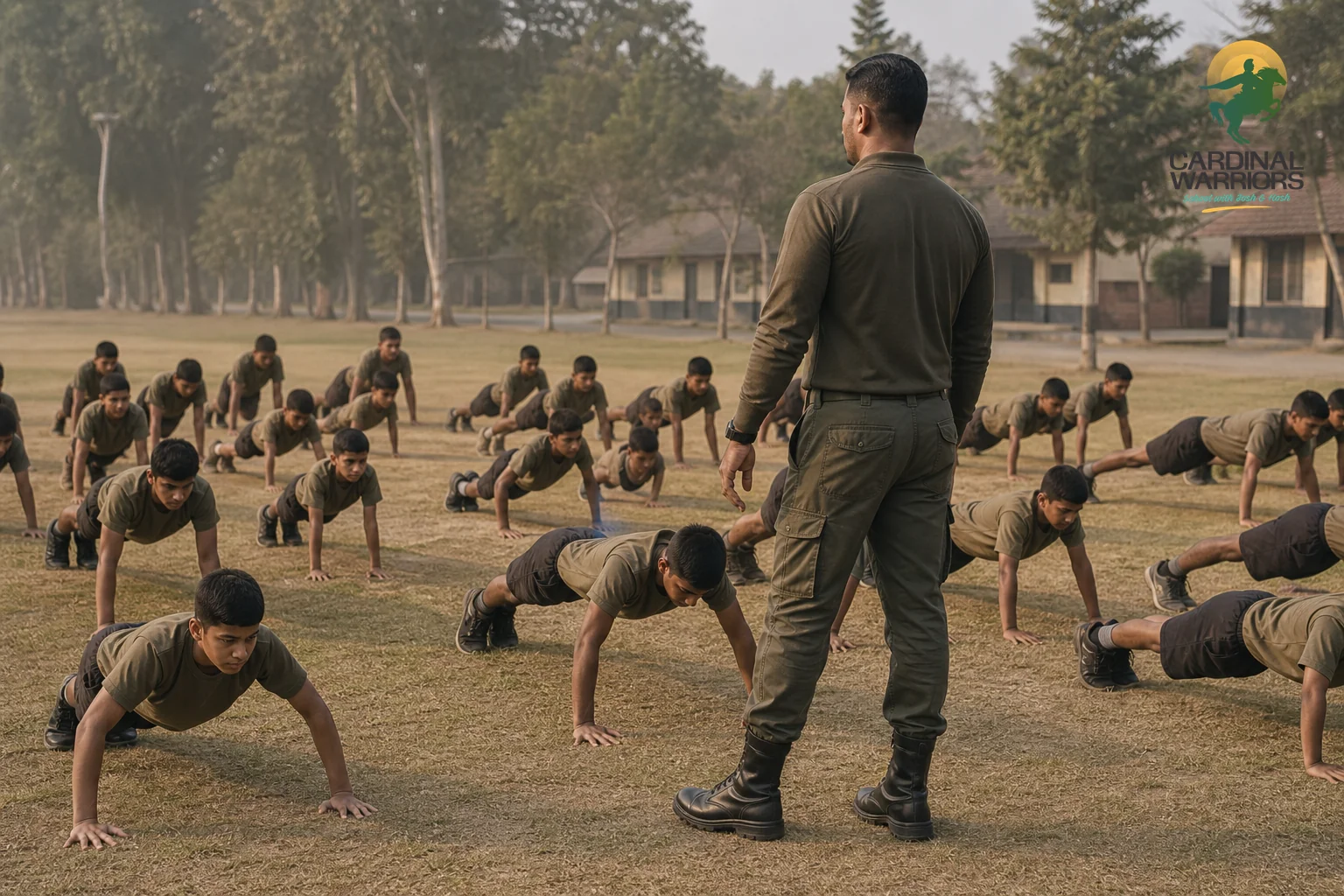
Daily 30-minute morning PT sessions, done consistently over years rather than crammed into a final term, build exactly this base. That consistency is the entire point of a residential structure: nobody has to remember to schedule the run, because the schedule is already fixed.
5. Fix Vision and Dental Issues Before the Medical Board
Correctable refractive errors within a set limit are generally acceptable with spectacles or approved corrective procedures, but some conditions, including certain degrees of colour blindness for specific wings or untreated squint, lead to outright rejection regardless of academic score. Dental issues like untreated cavities, missing teeth without proper replacement, or gum disease also show up on medical board checklists and can delay or derail a candidacy that looked strong on paper.
The fix is timing, not intensity. An eye check by Class 9, a dental check-up every six months, and correction of any issue found well before Class 12 gives a candidate two to three years of buffer instead of a scramble in the weeks after the written result. For the fuller list of conditions that trip up otherwise strong candidates, see NDA medical standards: the most common reasons candidates are rejected.
6. Build a Year-by-Year Fitness Timeline From Class 6 to Class 12
Physical readiness for the NDA isn’t a six-month sprint. It’s a staged build that maps neatly onto a child’s school years, which is exactly why starting early inside a structured school routine beats trying to compress everything into Class 11 and 12.
- Class 6-8: general fitness, swimming, basic obstacle familiarity, and correcting any vision or dental issues while there’s time to spare.
- Class 9-10: structured running plans, strength basics like push-ups and pull-ups, and first exposure to obstacle-course drills.
- Class 11: pace-focused running, sustained obstacle practice, and introduction to group task dynamics similar to GTO exercises.
- Class 12: full mock SSB physical simulations alongside written exam preparation, timed to peak around the NDA 2 2026 written exam on 13 September 2026 and the expected AISSEE 2027 notification window in September-October 2026 for families also weighing a Sainik School route.
Families comparing this staged approach against a purely academic coaching centre often ask how the two entry paths differ in preparation demands; the comparison in NDA vs CDS vs AFCAT: which defence route fits your child? is worth reading if the family hasn’t yet settled on which exam to target first.
7. What a Structured Boarding Routine in Nimora, Raipur Adds
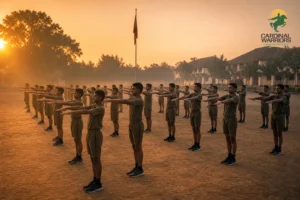
Cardinal Warriors runs its physical training on a 5-acre campus in Nimora, on Dhamtari Road near Mana, Raipur, with daily 30-minute morning PT and yoga built into the fixed timetable rather than left to a parent’s evening reminder. Obstacle courses and squad posts on campus are supervised by retired military personnel who have actually run these drills in service, not fitness instructors reading from a manual.
Psychometric testing and personalised career counseling run alongside the physical programme, so a family gets an honest read on whether a child’s temperament fits the defence route before years of preparation are invested. That combination, physical training under real supervision plus academic coaching for CBSE, NDA, AISSEE, RIMC and RMS in one campus, is what makes an early start practical instead of exhausting for a working parent managing school runs and homework on top of everything else.
For families weighing this residential model against a purely academic school, what holistic development really means at a military school covers how physical, academic and character training are meant to work as one system rather than separate boxes. Families specifically targeting Sainik School or RIMC entry alongside NDA prep may also find best RIMC & RMS prep schools in Chhattisgarh useful for comparing coaching structures across the state.
FAQs on NDA Physical Fitness Standards
Can wearing glasses disqualify a candidate?
Not on its own. Correctable refractive errors within the medical board’s accepted limit are generally permitted with spectacles or approved correction. Certain specific conditions beyond simple short or long sight can lead to rejection, so an eye specialist’s assessment ahead of the medical board is worth arranging early.
What if my child’s height falls short by 1-2 cm?
There’s no flexibility on the medical board’s measured height figure outside the defined relaxation categories for hill and northeastern states. If a child is close to the minimum in Class 9 or 10, tracking growth every few months with a paediatrician gives a realistic sense of whether they’ll clear it by Class 12.
How soon should physical training realistically start?
Class 6 to 8 is the ideal window for building general fitness and correcting any medical issues, since it leaves years rather than months before the written exam and medical board stage arrives.
Is swimming compulsory for NDA?
Swimming isn’t a standalone pass/fail requirement at the written exam stage, but it’s tested during training at the academy itself and builds exactly the chest expansion and lung capacity the medical board checks. Schools that include it in the regular sports schedule give candidates a head start.
A candidate who has run the same obstacle course fifty times before SSB day isn’t performing a new skill under pressure. They’re repeating a familiar one, which is precisely what a board is trying to distinguish.
Meeting NDA physical fitness standards is a multi-year project built on daily habits, not a checklist tackled after the written result arrives. If your child is aiming for the NDA 2 2026 written exam on 13 September 2026, or you’re already weighing the AISSEE 2027 notification expected between September and October 2026 as a parallel option, the time to start structured physical training is now, not after Class 12 begins. Read more about how Cardinal Warriors builds this training into daily school life, or explore more with us to see the campus and coaching structure in Nimora, Raipur. To discuss your child’s current fitness level and a realistic timeline before the next exam cycle, contact us directly. You can also follow ongoing training updates on Facebook, Instagram and Twitter / X.

You may also like
What Changes When a School Is Run by an Army Veteran
Homesickness in Boarding School: An Honest Look at Month One