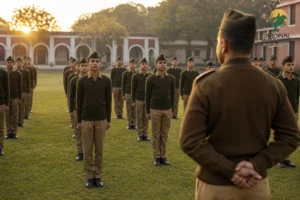
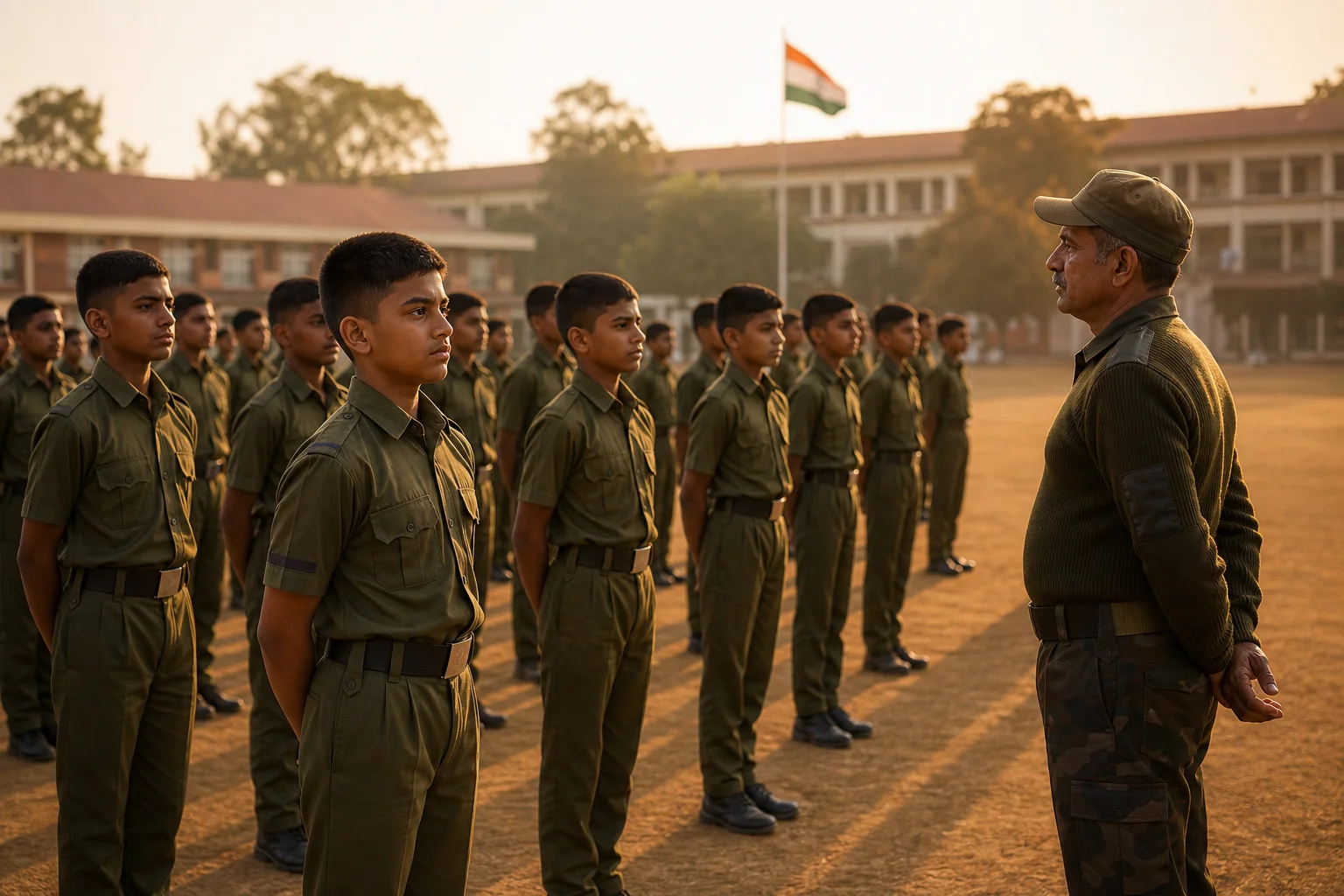
Best RIMC & RMS Prep Schools in Chhattisgarh
A Class 6 boy in Durg once came home from an RMS mock test and told his mother, “I knew all the answers, I just ran out of time.” That single sentence explains why so many bright children fail RIMC and RMS entrance exams even after months of tuition. These exams do not just test what a child knows. They test how fast a child thinks, how calmly a child speaks in front of strangers, and how fit a child’s body is. A regular school timetable, built around board exams, was never designed to build any of that.
This is the gap a genuine RIMC RMS preparation school in Chhattisgarh is meant to close. Parents in Raipur, Bilaspur, Durg, and Bhilai, along with families from Madhya Pradesh, Odisha, and Jharkhand who send children to boarding schools in the state, are increasingly asking a sharper question than “which school has good marks?” They are asking, “which school actually trains for RIMC and RMS every single day, not just before the exam date?” This guide walks through what these exams demand, what a real preparation program looks like from Class 5 through Class 8, and what to check before you enrol your child anywhere.
What RIMC and RMS Actually Demand From a Child
The Rashtriya Indian Military College (RIMC) in Dehradun admits boys between roughly 11.5 and 13 years directly into Class 8, through a written exam followed by an interview and a medical test. The written paper covers English, Mathematics, and General Knowledge, but the real filter is the interview board, which looks for a calm, articulate child who can think on his feet. Seats are limited nationally, and Chhattisgarh gets a fixed state quota, which makes early, focused preparation essential rather than optional.
Rashtriya Military Schools (RMS), spread across cities like Bengaluru, Belgaum, Chail, and Dholpur, admit students into Class 6 and Class 9 through the All India Sainik Schools Entrance Examination (AISSEE), the same national test used for Sainik Schools. You can verify current notifications and eligibility rules directly on the Rashtriya Military Schools official site and the National Testing Agency portal, which conducts the AISSEE each year.
Here is what makes both exams different from a school unit test:
- Speed under pressure: Children get a fixed, tight time window and must solve reasoning and maths problems without pausing to double-check every answer.
- Verbal clarity in the interview: RIMC in particular weighs the interview heavily. A child who freezes when asked “why do you want to join the Army?” loses out to one who has practiced answering that exact question calmly.
- Physical and medical standards: Both institutions run a medical test, so a child’s fitness, eyesight, and general health need attention months in advance, not the week before.
- General awareness beyond textbooks: Questions often touch current affairs, basic defence knowledge, and reasoning puzzles that a CBSE syllabus alone does not cover.
Because of these layers, coaching that only drills past-year question papers misses half the exam. A child also needs the composure and physical stamina that come from daily practice, not a weekend crash course.
Why a Military-Integrated School Is Different From Regular Tuition
Most families first try a private tutor or a weekend coaching class for RIMC or RMS. The problem shows up quickly: tuition can teach maths shortcuts, but it cannot teach a child to wake at five, run two kilometres, and still walk into an interview room with a steady voice. Those habits are built through routine, not through extra classes bolted onto an already full school day.
A military-integrated CBSE school folds RIMC and RMS preparation into everyday life instead of treating it as an add-on. At Cardinal Warriors, academics, physical training, and character-building run in parallel every day through a guiding school philosophy the institution describes as blending “energy with wisdom,” rather than in isolated blocks. A child preparing for RIMC or RMS is living the discipline the exam eventually tests, not memorising it the night before.
If you are still deciding whether this kind of environment fits your child’s temperament, our detailed piece on what military school education in India actually involves is a useful starting point before you commit to any preparation track.
Inside a Structured RIMC/RMS Preparation Program: What It Should Include
A genuine preparation program is not a single subject on a timetable. It is a combination of four elements working together, and a parent should be able to see all four clearly explained before enrolling.
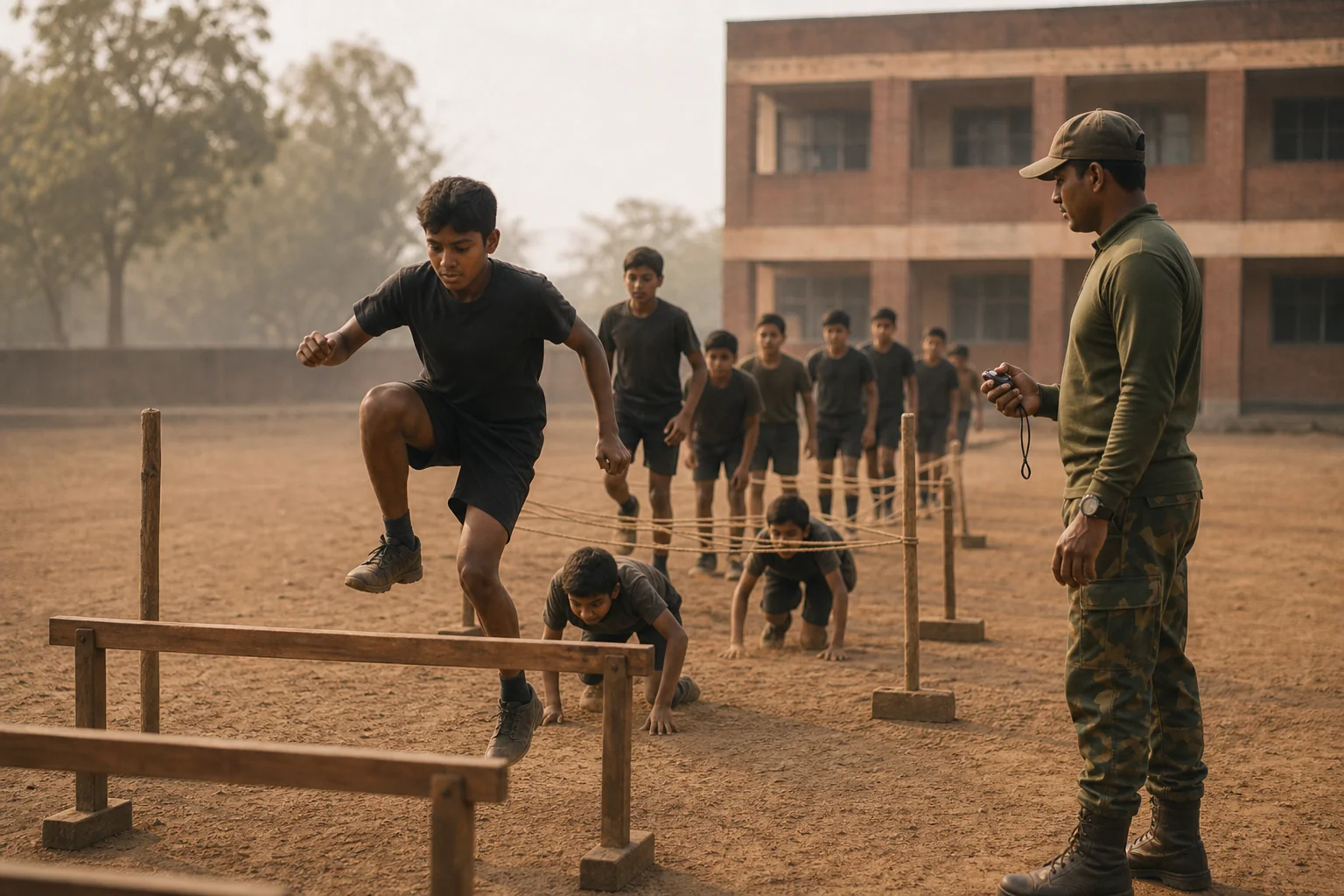
- Academic coaching: Strong foundations in Maths and English, daily reasoning and general knowledge drills, and regular mock tests built on the actual AISSEE and RIMC exam pattern rather than generic worksheets.
- Physical fitness training: Running, agility circuits, and obstacle drills that match the physical standards RIMC and RMS expect at their medical and fitness assessment stage.
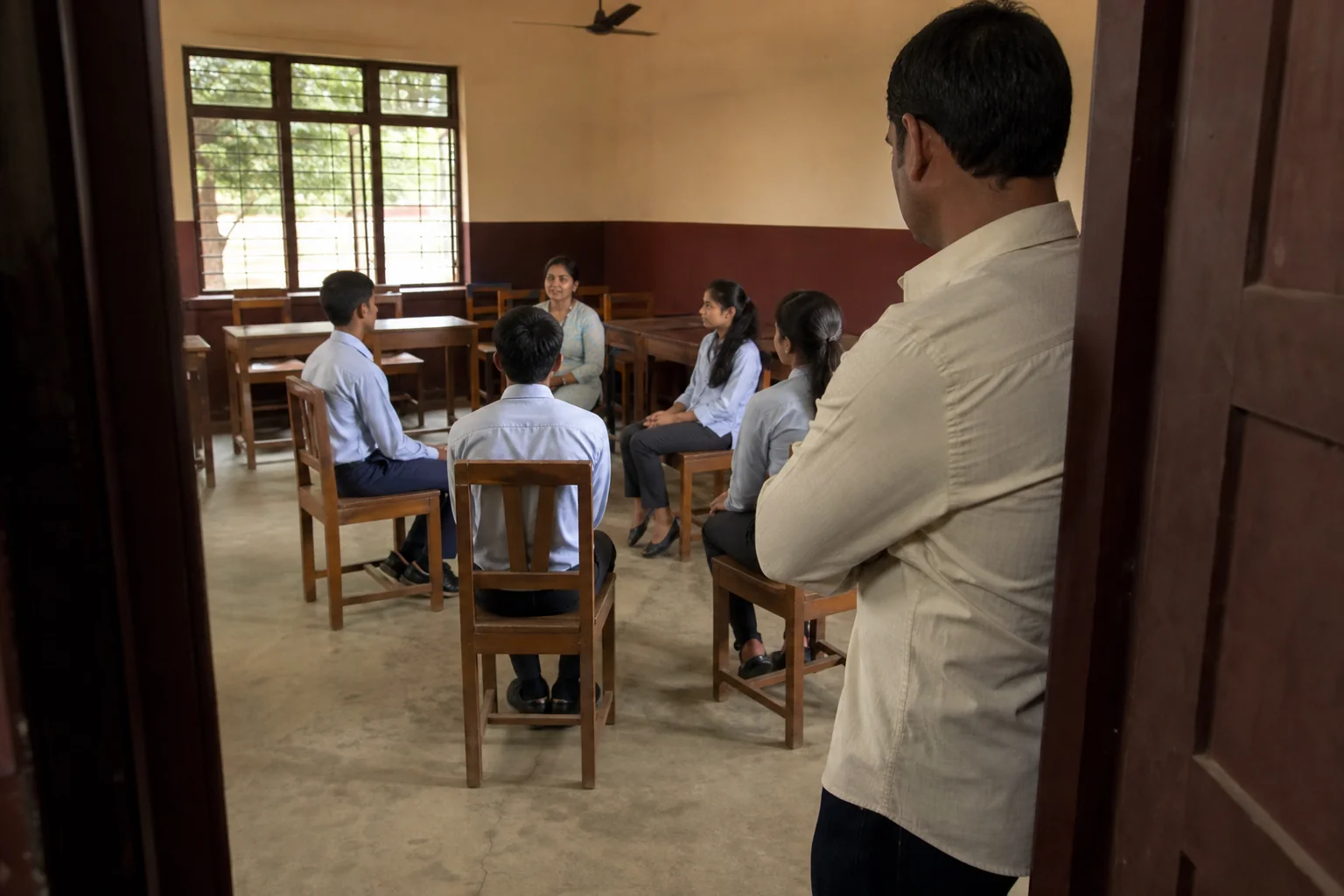
- Interview and viva readiness: Structured group discussions, one-on-one mock interviews, and body language coaching so a child’s first real interview isn’t the actual RIMC board.
- Character and leadership building: Woven into the daily hostel and classroom routine, not delivered as a separate “personality development” period once a week.
Interview readiness deserves special attention because it is where most otherwise well-prepared children lose marks. Our guide on the best SSB interview coaching schools in Chhattisgarh breaks down how structured mock panels are run and why they matter well beyond just the SSB stage of a defence career.
The Class 5 to Class 8 Preparation Timeline
Parents often ask when preparation should realistically begin. The honest answer is earlier than most families expect, because the advantage compounds year over year rather than appearing overnight.
- Class 5: Focus on reading habits, basic reasoning games, and introducing the idea of routine and discipline through daily schedules, not formal exam drilling yet.
- Class 6: This is the first real RMS entry window through AISSEE. Children who have built foundation skills in Class 5 get their first exposure to the actual exam pattern and timing here.
- Class 7: A bridge year. Reasoning speed and English comprehension are strengthened, and physical conditioning becomes more structured, since this is the year before the RIMC window opens.
- Class 8: The RIMC entry window. This year needs intensive mock testing, repeated interview simulation, and close attention to medical fitness requirements well ahead of the actual test date.
- Class 9: A second RMS entry window exists here for students who did not attempt or did not clear the Class 6 window, so preparation does not stop even if the first attempt doesn’t succeed.
Starting at Class 5 or 6 gives a child roughly two to three years of compounding practice before the exam that matters most. A child who begins serious preparation only a few months before Class 8 is competing against peers who have had years of daily reasoning drills, fitness training, and interview practice behind them. That gap is very hard to close quickly.
RIMC vs RMS vs Sainik School vs NDA Coaching: How the Pathways Compare
Families often confuse these four terms because they overlap in purpose but differ sharply in entry age, exam body, and what happens after admission. The table below lays out the practical differences side by side.
| Pathway | Entry Class / Age | Exam Body | Key Selection Stages | What Comes Next |
|---|---|---|---|---|
| RIMC | Class 8, age ~11.5-13 | RIMC written exam (own board) | Written test, personal interview, medical test | Priority pathway toward NDA after Class 12 |
| RMS | Class 6 and Class 9 | AISSEE (conducted by NTA) | Written test, medical test, increasingly interview-style assessment | Prepares for NDA, Sainik Schools’ network, and general defence pathway |
| Sainik School | Class 6 and Class 9 | AISSEE (conducted by NTA) | Written test, medical test | Feeds into NDA and broader defence and civil service aspirations |
| NDA Coaching | Typically starts Class 11-12 | UPSC NDA exam | Written exam, SSB interview, medical test | Direct entry to National Defence Academy after Class 12 |
RIMC is often described as a feeder institution because it sends its cadets into the NDA pipeline with strong preparation already behind them. RMS and Sainik Schools cast a wider net at Class 6 and Class 9 and prepare students broadly for the same eventual NDA and defence pathway, which is why our detailed comparison of Sainik School vs military school in Chhattisgarh is worth reading if you are still weighing these two options. NDA coaching, by contrast, usually begins later, in Class 11 or 12, and builds on the same reasoning, fitness, and interview skills that RIMC and RMS preparation instil years earlier. You can see how that later-stage coaching works in our guide to the best NDA coaching schools in Chhattisgarh.
What to Look for When Choosing a School for RIMC/RMS Coaching in Chhattisgarh
Marketing brochures use words like “defence preparation” loosely. Before enrolling, ask specific, verifiable questions rather than accepting general claims.
- Is there a documented weekly timetable showing when RIMC/RMS coaching happens, or is it an informal, occasional activity?
- Who runs the physical fitness sessions? Trainers with a defence or para-military background understand the actual fitness benchmarks RIMC and RMS expect, not just generic PE routines.
- How often are mock interviews conducted, and are they run as a genuine panel discussion, or a casual one-line question?
- What is the boarding supervision ratio? A safe, well-supervised campus matters as much as academic coaching, especially for parents sending children away from home for the first time. Our guide on what to look for in a disciplined boarding school covers the questions worth asking on a campus visit.
- Does the school track and share mock test results against the actual AISSEE and RIMC pattern, so you can measure real progress rather than take a claim on faith?
Parents evaluating any boarding option, regardless of which school they eventually choose, should also review general campus safety standards. Our piece on what is military school education in India walks through supervision, medical readiness, and communication protocols that every parent has a right to ask about.
How Cardinal Warriors Prepares Students for RIMC and RMS in Raipur
Cardinal Warriors was founded by Major Pravin Singh (Retd.), an Army veteran who built the school’s approach around lived military experience rather than a coaching-centre model borrowed from urban tuition chains. That distinction matters for RIMC and RMS preparation specifically, because the interview boards for both institutions are looking for the same qualities a career Army officer recognises immediately: composure, honesty, and a sense of purpose beyond marks.
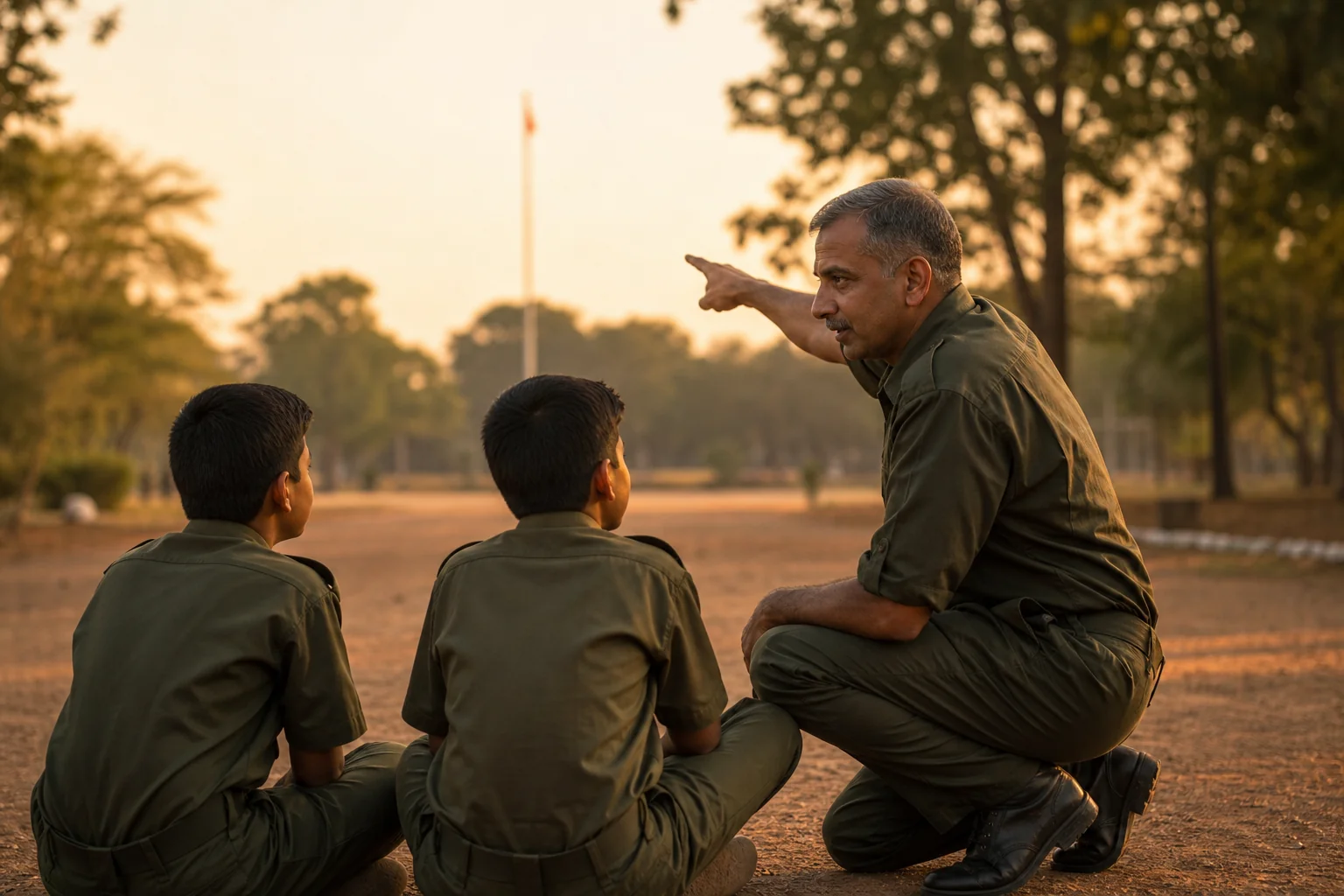
At the Raipur and Nimora campus, the school’s guiding approach runs through the daily schedule rather than sitting beside it. A student’s morning fitness session, classroom hour, and evening interview-practice group are all part of one continuous routine, not three unrelated activities managed by different departments. This structure directly answers the concerns many parents raise: working parents who cannot supervise homework and screen time every evening, children pulled toward mobile distraction instead of focused study, and a general worry that a regular day school leaves discipline and leadership entirely untaught.
Because Cardinal Warriors combines CBSE academics with dedicated RIMC, RMS, AISSEE, NDA, and SSB interview coaching under one roof, families do not need to patch together a school, a separate tutor, and a separate fitness coach. This also makes the school a practical option for families outside Chhattisgarh, in Madhya Pradesh, Odisha, and Jharkhand, who are searching for a single boarding institution that can carry a child from Class 5 foundation work through the Class 8 RIMC window without switching institutions midway. If you’d like to see how this compares against other options in the region, our roundup of the best military school in Raipur, Chhattisgarh lays out the broader picture, and our piece on how to choose the right military school for your child offers a checklist you can apply to any shortlist, including this one.
A child preparing for RIMC or RMS is not just studying for an exam. He is building the daily habits, physical stamina, and quiet confidence that the interview board is specifically trained to notice.
Frequently Asked Questions About RIMC & RMS Preparation
What is the right age to start RIMC or RMS preparation?
Most educators recommend starting foundation work by Class 5, so a child has two to three years of reasoning practice, fitness conditioning, and interview exposure before the Class 8 RIMC window or the Class 6 RMS window arrives.
Can girls apply to RMS and RIMC?
RMS has progressively opened admission to girls at several of its schools in recent years, following policy changes extended from the Sainik School network. RIMC has also begun admitting girl cadets in recent intakes. Always confirm the current year’s eligibility notification on the official RMS website before applying, since intake policies are updated periodically.
Is RIMC/RMS coaching useful only if my child wants to join the Army?
No. The reasoning speed, disciplined routine, and interview confidence built during RIMC/RMS preparation carry over directly into NDA coaching, SSB interviews, and even competitive exams like NEET and JEE, since all of these ultimately test focus and composure under pressure alongside subject knowledge.
How is RIMC/RMS coaching different from NDA coaching?
RIMC and RMS preparation targets Class 6 to Class 9 entry exams and builds foundational reasoning, fitness, and interview skills early. NDA coaching typically begins around Class 11 or 12 and prepares students for the UPSC-conducted NDA written exam and SSB interview, building directly on the habits formed during earlier RIMC/RMS-focused years.
Does Cardinal Warriors accept students from outside Chhattisgarh for RIMC/RMS preparation?
Yes. As a boarding school in Raipur, Cardinal Warriors regularly enrols students from Madhya Pradesh, Odisha, Jharkhand, and other states who are specifically seeking a structured, defence-oriented preparation environment rather than a purely local day-school option.
Start Your Child’s RIMC/RMS Journey the Right Way
Every year a child spends without structured reasoning practice, fitness conditioning, and interview exposure is a year a competing candidate is spending building exactly that advantage. Choosing the right RIMC RMS preparation school in Chhattisgarh early, ideally by Class 5 or Class 6, gives your child the compounding preparation that a last-minute coaching class simply cannot replicate.
If you want to see how Cardinal Warriors structures its CBSE academics, physical training, and RIMC/RMS/NDA/SSB coaching into one daily routine, take a moment to read more about our approach and campus. You can also explore more with us to understand how our founder’s Army background shapes everything from morning drill to interview practice, or contact us directly to discuss admissions for the upcoming academic year. For regular updates on campus life, admissions windows, and student progress, follow Cardinal Warriors on Facebook, Instagram, and Twitter/X. Your child’s path toward RIMC, RMS, and beyond can start with a single visit to our Raipur campus.

You may also like
SSB Interview Coaching: What Parents Should Know