
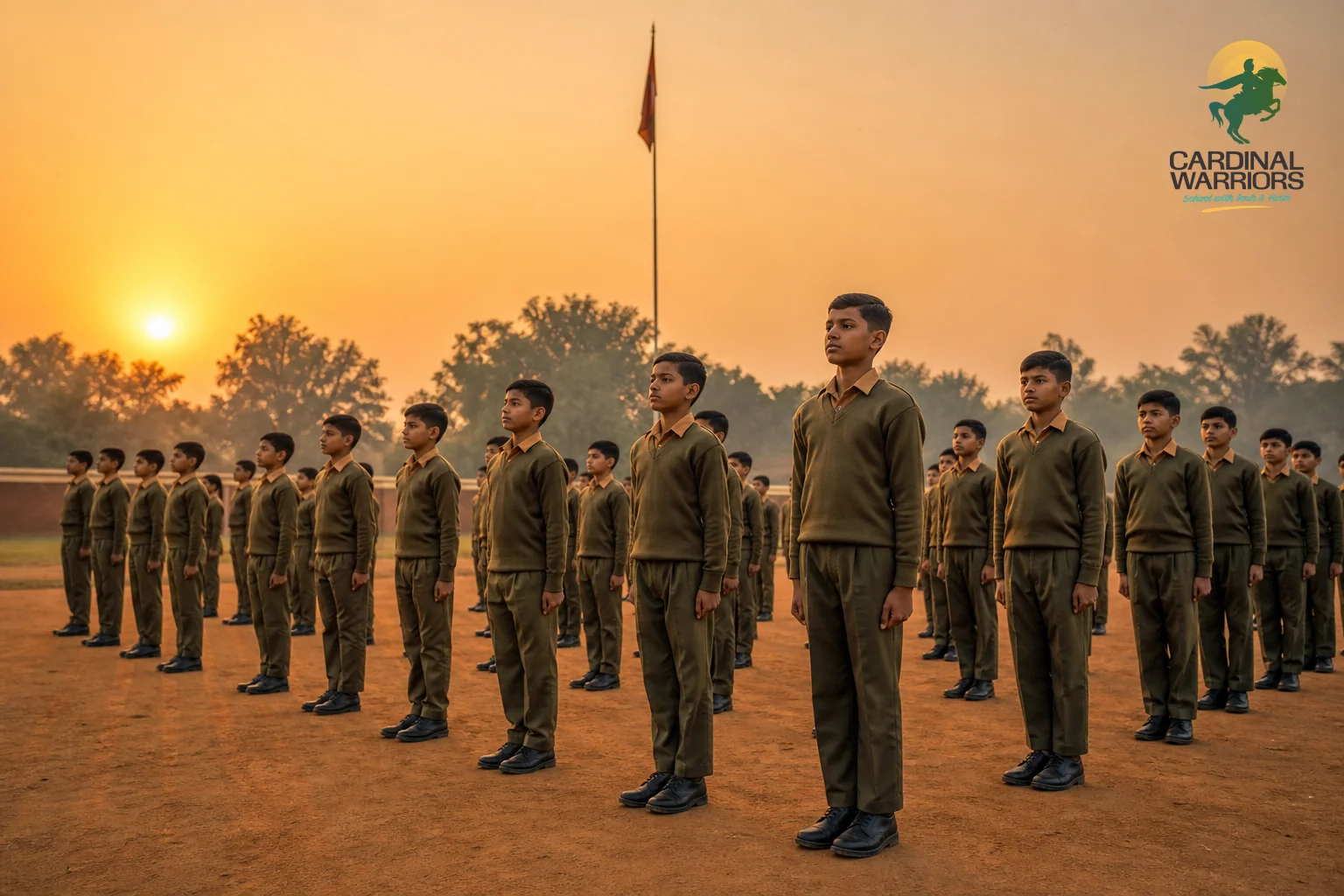
Boarding School vs Day School: Discipline in Chhattisgarh
For a child who needs real discipline, a residential military-integrated school beats a day school on almost every measure that matters: supervision hours, routine consistency, physical training, and career coaching. Day schools can teach the same syllabus, but once the bell rings at 2 PM, structure ends and the evening is left to chance. This comparison breaks down exactly where the two models diverge, so parents in Raipur and across Chhattisgarh can choose with clear eyes instead of a glossy brochure.
Key Takeaways
- Supervision gap: Day schools supervise for 6-7 hours; boarding schools supervise for close to 24, closing the evening gap where most discipline problems actually start.
- Routine beats reminders: Boarding schools run a fixed daily schedule for PT, study, and meals, while day-school routine depends entirely on parents enforcing it at home.
- Character building needs repetition: A once-a-week moral science period cannot compete with daily values drills, peer accountability, and mentorship from staff who live on campus.
- Career coaching is integrated, not outsourced: Boarding schools with military training combine NDA, RIMC, RMS, NEET, JEE and SSB coaching into the school day, cutting the coaching-institute commute many day-school families juggle.
- Chhattisgarh families are looking harder at boarding: Many parents from Raipur, Bilaspur, and Durg are now considering CBSE military-integrated boarding schools for the structure a day school simply cannot offer after 2 PM.
At a Glance: Boarding vs Day School for Discipline
| Parameter | Day School | Military-Integrated Boarding School |
|---|---|---|
| Daily supervision hours | 6-7 hours (school time only) | Nearly 24 hours, including evenings and weekends |
| Physical training frequency | 1-2 periods per week | Daily PT/yoga plus structured sports and drills |
| Character building method | Occasional assemblies, moral science periods | Daily values integration through routine and mentorship |
| Screen-time control | Left to parents at home | Structured evenings reduce unsupervised device use |
| Career coaching (NDA/NEET/JEE) | Usually outsourced to separate coaching institutes | Often integrated into the school day and staffed on campus |
| Best suited for | Families who can actively supervise evenings and weekends | Working parents or families wanting structured, round-the-clock discipline |
| Distance from home | Local, same city | Can be cross-state; national intake is common |
Why Discipline Is the First Question Parents Ask
Ask any parent in Raipur or Bilaspur what worries them most about raising a school-age child today, and the answer rarely starts with marks. It starts with focus. A ten-year-old glued to a phone screen instead of homework. A teenager who skips morning routine because nobody is home to enforce it. Discipline, in this context, is not about punishment. It is about consistent structure that a child can rely on every single day, whether or not an adult is standing over their shoulder.
That is exactly why the boarding school vs day school for discipline question keeps coming up across Chhattisgarh. Families here share the same concerns: working parents with limited evening bandwidth, growing competition for defence and professional entrance exams, and a generation of children more comfortable with a screen than a schedule. The school model a family picks often decides which of these problems gets solved and which one lingers.
1. Academic Focus: Structured Day vs Flexible Evening
Day schools deliver a full CBSE curriculum, often taught well, inside a fixed classroom day. The catch is what happens after 2 or 3 PM. Homework, revision, and doubt-clearing depend on whoever is at home, and in many dual-income households across Raipur, Bhilai and Korba, that supervision simply is not consistent. A child might have brilliant teachers for six hours and zero academic structure for the other sixteen.
Boarding schools close that gap by running supervised study periods, or “prep,” after class hours. Teachers or resident staff are present to clear doubts, monitor homework completion, and keep the evening productive rather than unstructured. The academic content might be identical to a day school’s CBSE syllabus, but the consistency of application is not. For families researching what to look for in a disciplined boarding school, this after-hours structure is usually the deciding factor, not the classroom curriculum itself.
2. Character Building and Values Formation
Most day schools genuinely try to build character through weekly assemblies, moral science classes, or the occasional value-based competition. The intention is sound. The frequency is the problem. Character is not formed by a single lesson; it is formed by repetition, by small daily choices that get noticed and corrected.
Military-integrated boarding schools build this repetition into the schedule itself. At Cardinal Warriors in Raipur, daily conduct is shaped around a defined set of core values, ownership, discipline, courage, and empathy, expressed through routine rather than treated as an abstract classroom topic. Staff, many of them retired military personnel, live and work alongside cadets, which means accountability happens in real time, not just during a scheduled period. Readers exploring whether military school is good for character building will find this daily-repetition model is precisely why residential programs tend to outperform day schools on this measure.
Discipline that only shows up during school hours is a habit. Discipline that shows up at 5 AM with no one watching is character.
3. Physical Training and Health Discipline
Physical education in most day schools is limited to one or two periods a week, often the first casualty when exam pressure builds. Health and fitness routines, sleep schedules, and nutrition are left almost entirely to parents, which is difficult to manage consistently in busy households across Chhattisgarh.
Boarding schools with military integration take a fundamentally different approach. A structured 30-minute morning PT and yoga session, obstacle course training, and organized sports like football, hockey, boxing, and horse riding are built into the daily timetable, not treated as optional extras. This daily physical routine does more than build fitness. It reduces the hours available for aimless phone use and gives children a tangible, repeated experience of pushing through discomfort and improving, which is a discipline lesson no classroom lecture can replicate.

4. Supervision: Who Is Watching When Parents Are Not?
This is where the gap between the two models is widest. A day school’s responsibility for a child effectively ends at the school gate. Everything from 3 PM to bedtime, homework, screen time, meals, and sleep, depends on parents or domestic help. For working parents in cities like Raipur, Bhilai, or Bilaspur, that stretch of unsupervised time is often where discipline habits quietly erode.
Boarding schools remove that gap almost entirely. Wardens, teaching staff, and military-trained mentors are present through the evening and night, managing everything from study hours to lights-out. This is not about restricting freedom; it is about ensuring a child’s day has structure at every hour, not just during school time. For parents who cannot physically supervise every evening, this round-the-clock model directly addresses one of the biggest reasons families start comparing military school and traditional boarding schools for discipline in the first place.
5. Career Preparation: NDA, RIMC, RMS, NEET, JEE and Beyond
Ambitious families across Chhattisgarh increasingly want more than a good CBSE result. They want a pathway into the National Defence Academy, RIMC, RMS, or competitive medical and engineering seats through NEET and JEE. In a typical day school setup, this means a second commute every evening to a separate coaching institute, on top of a full school day. The result is a tired child juggling two systems that rarely talk to each other.
Military-integrated boarding schools fold this preparation directly into the academic calendar. At Cardinal Warriors, coaching for NDA entrance, AISSEE, RIMC and RMS preparation, NEET, IIT/JEE, and CA Foundation runs alongside regular CBSE classes, taught by experienced educators and retired military personnel who understand both the academic syllabus and the physical and psychological demands of an SSB interview. Psychometric testing and personalized career counseling are built into the routine rather than bolted on as an afterthought, which is central to how parents should choose the right military school for their child.

Boarding School vs Day School: Side-by-Side Comparison
| Factor | Day School | Boarding School (Military-Integrated) |
|---|---|---|
| Structured routine | Only during school hours | Full day, including evenings and weekends |
| Discipline enforcement | Depends on parents at home | Consistent, staff-led, campus-wide |
| Leadership opportunities | Limited to prefect roles or clubs | Daily squad structure, peer responsibility, drills |
| Defence exam coaching (NDA/RIMC/RMS) | Usually external, added cost and travel | Often integrated into the school timetable |
| Medical/engineering coaching (NEET/JEE) | Separate coaching institute required | Can be offered on-campus alongside CBSE academics |
| Parental time commitment | High, especially evenings and weekends | Lower day-to-day, higher trust in the institution |
| Social and peer environment | Limited to school hours | Continuous peer accountability and mentorship |
What About Parents Outside Raipur Considering a Boarding School?
Chhattisgarh has strong day schools and a small number of Sainik Schools, but the specific combination of CBSE academics, daily military training, and integrated defence-and-competitive-exam coaching is still rare. Because of that, a growing number of families from Bilaspur, Durg, Korba, and Raigarh are looking at residential military-integrated schools around Raipur, which has developed into something of a hub for this specific school model.
Distance matters less than parents assume once a school runs on a genuine boarding model. Rail and road connectivity between Raipur and the rest of Chhattisgarh is well established, and a residential school is, by design, built for students who live away from home for most of the academic year. The real question for a family is not “how far is Raipur,” but whether the school’s daily structure, supervision, and career coaching justify the move. For many, comparing Sainik School and private military school options in Chhattisgarh has become part of that decision, since seat availability in government Sainik Schools is limited and admission is highly competitive, as noted on the official Sainik School Society admissions portal.
How Military-Integrated Boarding Schools Close the Gap
The strongest argument for a military-integrated boarding school is not that it replaces academics with drill practice. It is that it layers structure, physical training, and character formation on top of a standard CBSE curriculum, without asking a child to sacrifice one for the other. Cardinal Warriors runs this as one integrated system covering military education, tactical training, academic learning, and sports, rather than four separate activities competing for a child’s time.
Behind that framework sits the goal of building well-rounded, officer-like qualities in every cadet, alongside enthusiasm balanced with sound judgment. Mentorship comes from staff and patrons with real military background, including senior leadership guidance from the school’s founding team, which gives the discipline model credibility beyond a marketing phrase. According to the Ministry of Education, Government of India, CBSE-affiliated schools must meet defined infrastructure and curriculum standards, and Cardinal Warriors operates under CBSE School Code 16180 within this framework. For parents who have read about what military school education actually involves in India, this is the practical, day-to-day version of that theory: structured mornings, supervised study, daily fitness, and career coaching, repeated until it becomes habit rather than instruction.
Making the Right Choice for Your Child
Day schools remain a reasonable choice for families who can commit real time every evening and weekend to enforcing routine, monitoring screen use, and coordinating separate coaching for competitive exams. If a parent is home consistently, engaged in homework checks, and able to manage a child’s fitness and study schedule without external structure, a good day school can work well.
Boarding schools with military discipline make more sense when:
- Both parents work and cannot supervise evenings consistently.
- The child struggles with focus, screen addiction, or self-motivation without external structure.
- The family is targeting NDA, RIMC, RMS, NEET, or JEE and wants integrated coaching instead of running between multiple institutes.
- Character building and leadership exposure matter as much as academic results.
- The family values continuous supervision over daily proximity to the child.
Before choosing either model, visit the campus in person. Ask to see a normal weekday, not a curated open house. Watch what happens at 6 AM and at 9 PM, since that is where the real difference between a day school and a disciplined boarding school shows up. Families that have gone through this process often say the campus visit, more than any prospectus, is what changed their decision, a point covered in more depth in what to look for in a disciplined boarding school.
Frequently Asked Questions
Is boarding school really better than day school for discipline?
For most children who need consistent, external structure, yes. Boarding schools supervise nearly the entire day, while day schools rely on parents to enforce routine after school hours. The better fit depends on how much evening supervision a family can realistically provide.
Can a child from a day school still prepare for NDA or NEET?
Yes, but usually through a separate coaching institute, which adds travel time and a second schedule to manage. Boarding schools with integrated coaching, like NDA and NEET preparation offered alongside regular CBSE classes, reduce this burden by keeping everything on one campus. Learn more about how military school improves discipline and focus for exam preparation specifically.
What age is right for a child to join a military-integrated boarding school?
Many schools, including Cardinal Warriors, admit students from pre-primary through higher secondary, so there is no single “correct” age. Younger children often adapt to routine faster, while older students joining specifically for NDA, RIMC, or RMS coaching typically enter around Class 6 to Class 9.
Do students from outside Raipur get admission into these military schools?
Yes. Most CBSE-affiliated military-integrated boarding schools in Chhattisgarh, including those in Raipur, run a national intake model and regularly admit students from across the state and the rest of India.
Is a boarding school safe for a younger child?
Reputable residential schools maintain round-the-clock supervision through wardens and staff, structured routines, and secure campuses specifically because younger boarders need more oversight, not less. Parents should verify staff-to-student ratios and daily supervision schedules before enrolling a young child.
Choosing between a boarding school and a day school ultimately comes down to one question: who is responsible for your child’s discipline when the school day ends? If the honest answer is “no one, consistently,” a military-integrated boarding school is built to fill exactly that gap, combining CBSE academics with daily physical training, character formation, and integrated career coaching for NDA, NEET, JEE, and defence services. Read more about Cardinal Warriors’ approach to disciplined, holistic education and see how the daily training framework translates into campus life. Parents in Raipur and across Chhattisgarh can explore more about admissions and campus life or contact us directly to plan a visit and see the routine for themselves before making this decision. You can also follow ongoing campus updates on Facebook, Instagram, and Twitter/X.

You may also like

Military School vs Sainik School: Admissions Compared

Military School vs Regular School in Chhattisgarh