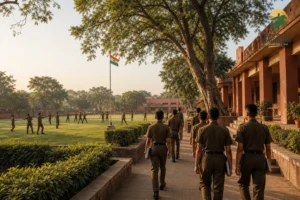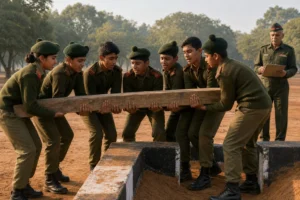
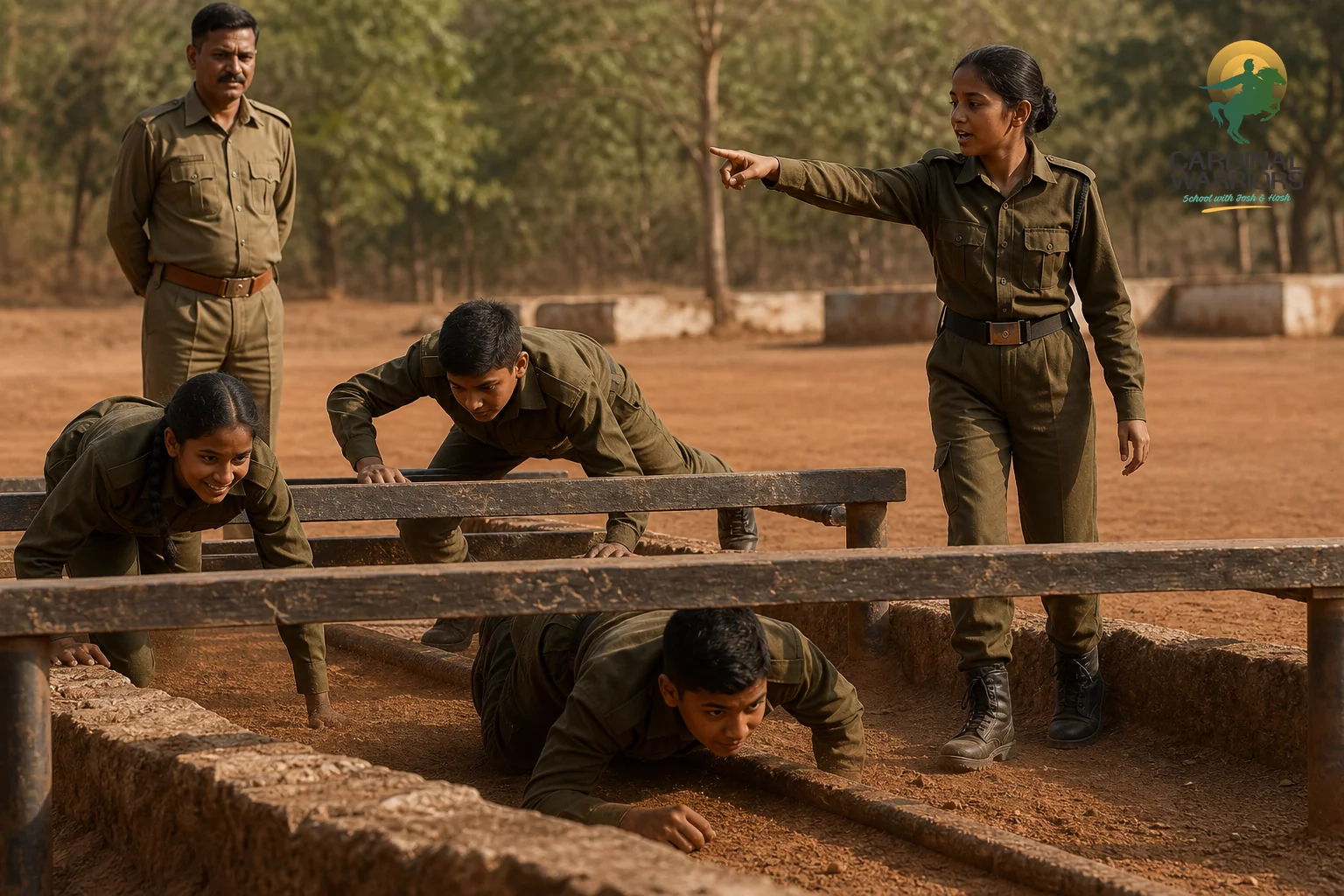
Leadership Development Schools in Chhattisgarh: What to Look For
A genuine leadership development school in Chhattisgarh does not announce leadership on a banner and hope it happens. It builds a daily structure where children take real responsibility, face real consequences, and get corrected by adults who have actually led people under pressure. That structure, not a certificate or a one-day workshop, is what separates a school that talks about leadership from one that trains it.
Key Takeaways
- Leadership is a daily system, not an event: Look for schools where responsibility rotates through squads, ranks, or duty rosters every week, not just during an annual camp or competition.
- Military-integrated schools structure leadership differently than regular CBSE schools: Formation drills, tactical exercises, and squad accountability create daily leadership reps that classroom electives cannot replicate.
- Mentorship matters as much as method: Schools staffed by retired defence personnel and experienced educators correct behaviour with lived authority, not just a rulebook.
- Academics and leadership should reinforce each other: The strongest programmes pair leadership training with structured coaching for NDA, RIMC, RMS, NEET, JEE, or CA Foundation, so character growth supports exam performance instead of competing with it.
- Ask for specifics on a campus visit: A credible school can show you a weekly duty roster and a career-assessment process, and can name its instructors, not just recite a mission statement.
At a Glance: Evaluating a Leadership Development School
| Evaluation Criteria | Regular CBSE Day School | Military-Integrated Residential School (e.g., Cardinal Warriors) | Sainik School / RMS |
|---|---|---|---|
| Daily leadership structure | Rare; limited to prefect system or clubs | Daily squad duties, rank rotation, morning PT command roles | Structured, but seat availability is very limited |
| Mentorship by defence-experienced staff | Uncommon | Common; retired military personnel on faculty | Common |
| Admission process | School-specific, generally easier | School-specific, flexible timelines through the year | National AISSEE exam, highly competitive |
| Integrated defence exam coaching (NDA, RIMC, RMS, SSB) | Not offered | Built into the school programme | Focused mainly on Sainik/RMS pathway |
| NEET/JEE/CA Foundation coaching | Sometimes via external tuition | Integrated on campus | Not typically offered |
| Boarding supervision | Not applicable (day school) | Full residential supervision, 5-acre campus | Full residential supervision |
| Physical training frequency | 1-2 periods per week | Daily 30-minute PT/Yoga plus tactical training | Daily |
| Career counseling | Generic, often outsourced | Assessment-based, with personalised counseling | Varies by school |
What Genuine Leadership Development Actually Looks Like in a School
Most school prospectuses use the word “leadership” somewhere on the cover page. Very few can show you what that word means on a Tuesday morning in March. Real leadership development in a school setting has a few non-negotiable ingredients: rotating responsibility, peer accountability, decision-making under mild pressure, physical challenge, and correction from someone who has actually led a team before.
Rotating responsibility means a child isn’t a “leader” once a year during an elocution competition. They lead a squad for PT one week, manage a duty roster the next, and answer for a teammate’s lapse the week after. Peer accountability means classmates, not just teachers, notice when someone doesn’t pull their weight. Decision-making under pressure comes from timed drills, obstacle courses, or tactical exercises where hesitation has a visible cost, not from a debate club where the only consequence is a lower score.
Physical challenge matters because discomfort reveals character faster than a classroom ever will. A child who can organise a group project in air-conditioned comfort behaves very differently when the group is tired, muddy, and running out of time. Schools serious about leadership use physical training as a lab for exactly that kind of pressure, not just a fitness requirement.
Finally, mentorship from adults with real command experience changes the quality of feedback a child receives. A teacher who has managed a platoon corrects a hesitant decision differently than one who has only managed a classroom. That distinction is worth asking about directly when you compare a military school education against a conventional academic-only option.
Why a Leadership Development School in Chhattisgarh Matters Right Now for Raipur Families
Raipur has no shortage of CBSE schools competing mainly on board exam percentages and rank lists. That competition is useful for academics, but it rarely produces a structured system for building responsibility, focus, or composure under pressure. Parents across Chhattisgarh increasingly notice the gap between a child’s report card and a child’s ability to organise a task, own a mistake, or lead a small group without adult prompting.
Two local pressures make this gap more urgent than it was a decade ago. First, many households in Raipur, Bhilai, Bilaspur, and Durg have both parents working full-time, leaving less daily time to supervise homework, routine, and screen habits. Second, mobile phone access has pulled children’s attention toward short-form content and away from sustained, effortful tasks, weakening exactly the focus and follow-through that leadership requires.
A structured leadership development school in Chhattisgarh addresses both pressures directly. Boarding removes the daily supervision gap by placing trained staff in charge of routine, discipline, and screen boundaries around the clock. A packed schedule of PT, tactical training, academics, and sports leaves little room for the drift that unsupervised free time tends to create. Families weighing this trade-off often start by reading about what to look for in a disciplined boarding school before narrowing their shortlist.
There is also a growing local interest in defence and competitive government careers, driven partly by Chhattisgarh’s own strong recruitment culture in the armed forces and paramilitary services. Parents preparing children for the NDA entrance pathway or a RIMC or RMS entrance exam want a school where leadership training and exam preparation happen under one roof, not as two competing demands on a child’s evening.
Military-Integrated Schools vs Regular CBSE Schools: How Leadership Training Differs
The comparison table above outlines the structural differences, but the daily experience is where the real gap shows up. A regular CBSE day school typically builds leadership opportunities through a prefect system, a handful of clubs, and inter-school competitions. These are useful, but they touch a small percentage of students and operate for a few hours a week at most.
A military-integrated school builds leadership into the rhythm of every single day. Morning formation requires someone to call the parade to order. Squad-based living requires someone to check that bunks are made and kits are packed. Tactical training exercises require a rotating “section commander” who must give clear instructions to peers under a time limit. None of this depends on a child volunteering for an extracurricular; it is simply how the day runs.
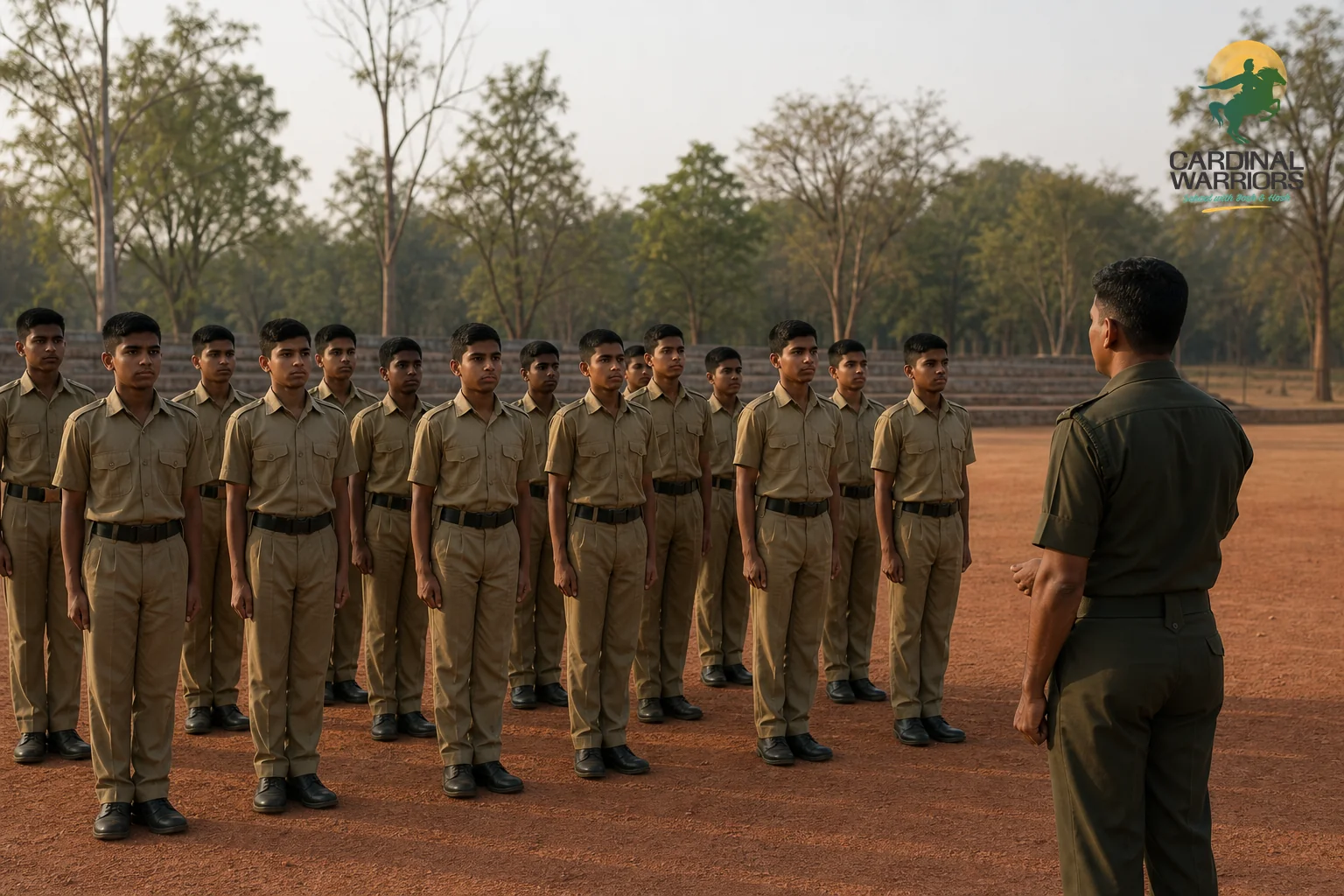
Sainik Schools and Rashtriya Military Schools (RMS) share some of this structure, since they were designed with defence preparation in mind. The practical constraint for most Chhattisgarh families is seat availability: RMS and Sainik School admissions run through a single national entrance exam with a small number of seats per state, which is why many parents also compare a Sainik School vs military school option in Chhattisgarh before deciding, or look closely at how military school training improves discipline and focus compared to a standard admissions cycle at a private CBSE school.
Private military-integrated schools generally offer more flexible admission timelines and, in many cases, broader career coaching that extends beyond a purely defence pathway. This is a meaningful distinction for a family whose child may ultimately choose NEET, JEE, or CA Foundation over a defence commission, but still wants the same daily leadership structure along the way.
What to Look For When Choosing a School Focused on Leadership
A school visit or prospectus review should answer specific, concrete questions rather than relying on the word “leadership” printed in a brochure. Use the checklist below when comparing schools around Raipur or elsewhere in Chhattisgarh.
- Is there a documented daily routine? Ask to see a sample day, hour by hour, including PT, academics, tactical training, and free time. A vague answer is a warning sign.
- Who holds responsibility positions, and how often do they rotate? A credible programme rotates squad leaders, duty officers, or class monitors regularly so more children get real leadership repetitions, not just a fixed few.
- Who is teaching discipline and leadership? Ask specifically whether instructors include retired military personnel or educators trained in structured mentorship, not only subject teachers doubling as supervisors.
- Is there a measurable assessment process? A structured career-assessment and counseling process shows a school is tracking a child’s development, not guessing at it.
- How does leadership training connect to academic and career goals? A strong programme should be able to explain how discipline and focus translate into better preparation for board exams, NDA, RIMC, RMS, NEET, JEE, or CA Foundation.
- What happens when a child struggles? Ask how the school handles a student who resists structure early on. The answer reveals whether the system is genuinely developmental or simply punitive.
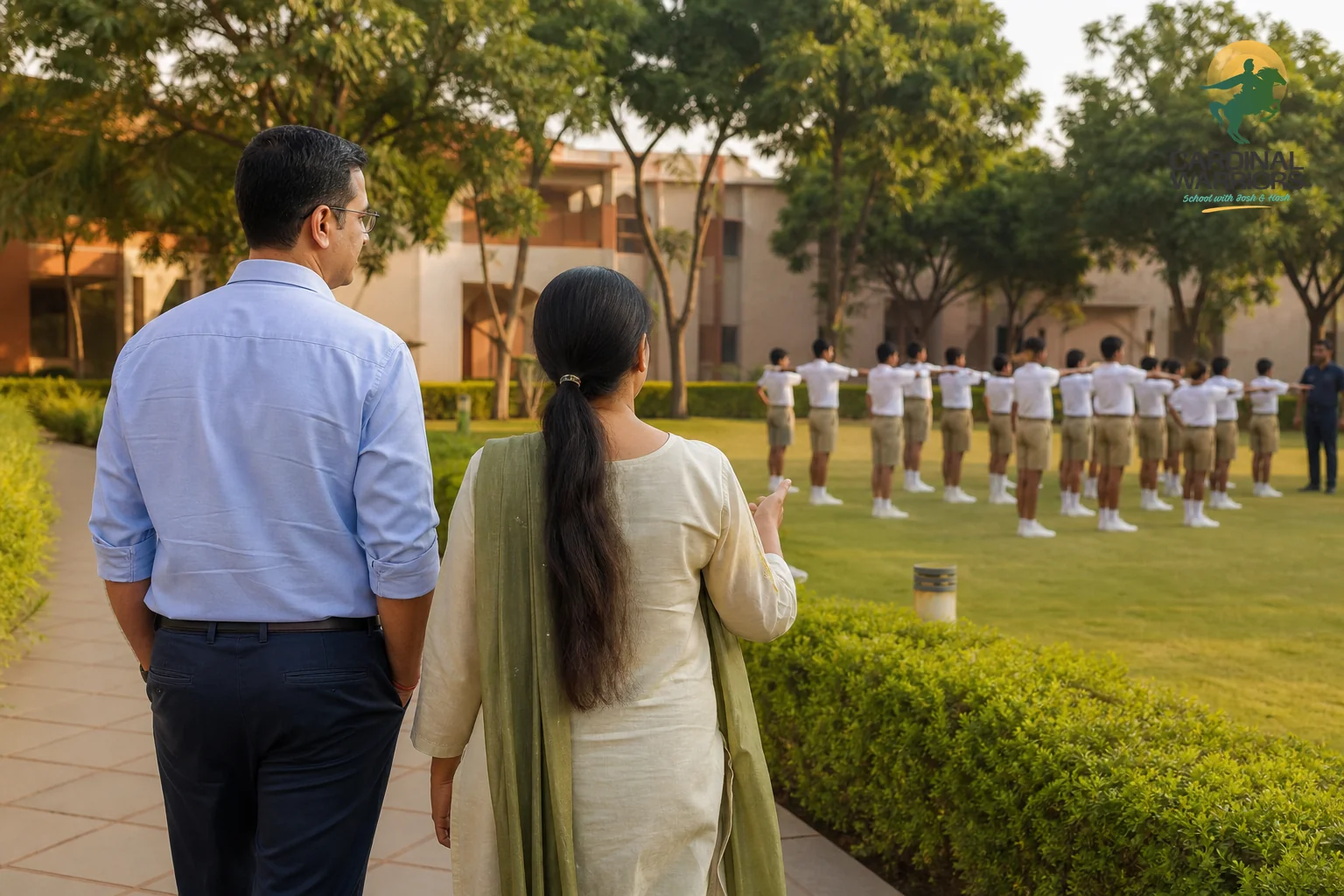
Families who want a fuller framework for this kind of evaluation can also review how to choose the right military school for your child, which covers admissions timing, campus safety, and fee structure alongside leadership criteria. It’s worth pairing that research with a direct campus visit, since a five-acre campus with obstacle courses and squad posts looks very different in person than it does in a photograph.
How Cardinal Warriors Builds Leadership Through Structured Daily Training
Cardinal Warriors, established in 2021 as Chhattisgarh’s first military-discipline school, structures leadership development around its own framework combining Military Education, Tactical Training, Academic Learning, and Sports. Rather than treating leadership as a separate subject, this approach threads it through every part of the school day on the school’s five-acre residential campus in Nimora on Dhamtari Road, Raipur.
Each cadet’s day begins with a mandatory 30-minute morning PT and yoga session, followed by structured military training that includes obstacle courses and duty at designated squad posts. These are not symbolic exercises. They require a rotating set of cadets to organise their peers, manage time, and take responsibility for outcomes, exactly the kind of daily leadership repetition described earlier in this guide.
Academic instruction follows the CBSE curriculum (School Code 16180) from pre-primary through higher secondary, supported by smart classrooms, science and computer labs, and a library of more than 3,000 books. Values training runs alongside academics through the school’s own code of conduct framework, aimed at building Officer Like Qualities and what the school calls disciplined energy guided by sound judgment rather than impulse.
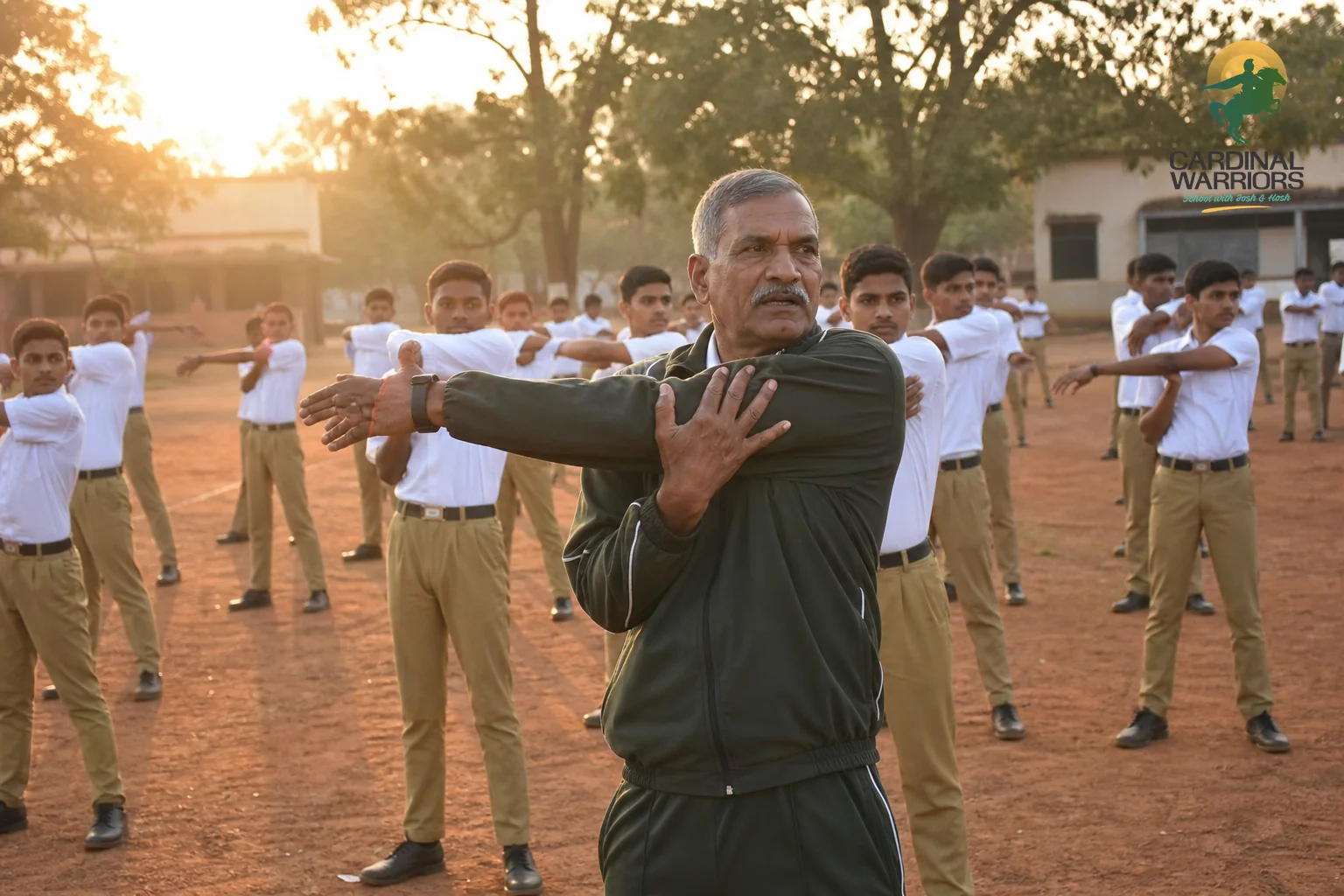
Instruction and mentorship come from a mix of experienced educators and retired military personnel, under the guidance of Director Major Pravin Singh, an Army veteran, and senior patrons including Chief Patron Lt. Gen. Krishna Mohan Seth, PVSM, AVSM (Retd). This lived command experience is precisely the mentorship quality that distinguishes structured leadership training from a generic “confidence-building” workshop. Career guidance is backed by structured assessment and personalised counseling, helping each cadet identify whether their strengths point toward a defence career, a medical or engineering path, or a professional stream like CA Foundation.
Families weighing fee structure alongside programme depth can review a full breakdown in the CBSE military boarding school fees guide or the broader 2026 boarding military school costs overview for India, both useful for comparing Cardinal Warriors against other residential options.
Leadership Beyond the Parade Ground: Academics, Sports and Career Readiness
Leadership training only earns its place in a school if it strengthens outcomes that parents actually care about: board results, competitive exam performance, and a child’s readiness for adult responsibility. At Cardinal Warriors, integrated coaching for NDA, AISSEE, RIMC, and RMS runs alongside NEET and IIT/JEE preparation and CA Foundation coaching, with dedicated SSB interview guidance for cadets aiming at a defence commission.
The connection between daily discipline and exam performance is not incidental. A child who has practised giving clear instructions under time pressure during a tactical drill tends to handle a timed SSB group task with more composure. A child whose focus has been trained through daily PT and a screen-limited boarding routine tends to sustain longer, more consistent study sessions for NEET or JEE than one accustomed to constant digital interruption. Parents researching this connection often compare notes with the guide on SSB interview coaching schools in Chhattisgarh.
Sports and co-curricular activity add a second leadership channel outside the classroom. Football, hockey, cricket, basketball, and boxing all require someone to organise a team on the field in real time. Horse riding, dance, and art build a different kind of composure and self-management. Together with the WiFi-enabled campus and smart classrooms, these activities round out a routine where leadership is practised in as many contexts as possible, not confined to a single drill or subject.
A child who leads a squad through an obstacle course on Monday and a study group through a NEET revision plan on Friday is building the same underlying skill twice: the ability to take responsibility and follow through.
Parents comparing this integrated model against other well-known institutions can also read the direct comparison in Military School vs Doon School: Which Builds Discipline?, which looks specifically at how structured, defence-oriented programmes stack up against traditional elite boarding schools on discipline and leadership outcomes. According to the Central Board of Secondary Education, CBSE-affiliated schools are expected to build life skills and values education into their curriculum framework, a mandate that structured military-integrated schools are especially well placed to fulfil through daily practice rather than occasional workshops. The Ministry of Education, Government of India similarly emphasises holistic, competency-based development under the National Education Policy, reinforcing why parents are increasingly looking beyond marks alone.
Questions Parents in Raipur and Chhattisgarh Commonly Ask
At what age should a child join a leadership development school?
Many families in Chhattisgarh start as early as pre-primary, since younger children absorb daily routine and structure with less resistance. Cardinal Warriors accepts students from pre-primary through higher secondary, so families can also enrol older children preparing specifically for NDA, RIMC, or RMS entrance exams.
How is leadership training different from a Sainik School programme?
Sainik Schools and RMS follow a similar structured, residential model but admit students through a single national entrance exam with limited seats. A private, CBSE-affiliated military-integrated school typically offers more flexible admission timing and adds broader coaching for NEET, JEE, and CA Foundation alongside defence exam preparation.
Will a structured leadership programme add unnecessary pressure to my child’s academics?
When leadership training is well-integrated, it tends to support academics rather than compete with it, since improved focus and time management carry over into study habits. This is exactly why character building through military school is usually discussed alongside, not instead of, academic performance.
What should I ask about cost before enrolling?
Ask for an itemised fee breakdown covering tuition, boarding, uniforms, and specialised coaching, rather than a single lump-sum figure. The military school fees in India guide is a useful starting point for understanding how these categories typically break down nationally before comparing Chhattisgarh-specific numbers.
Does a military-integrated school suit a child who is not aiming for a defence career?
Yes. The leadership, discipline, and focus built through daily structure apply equally to a future doctor, engineer, or chartered accountant. That is precisely why schools like Cardinal Warriors pair military training with NEET, JEE, and CA Foundation coaching rather than treating defence preparation as the only outcome.
Choosing a leadership development school in Chhattisgarh comes down to one practical test: can the school show you, in specific and concrete terms, how a child takes on responsibility every single day, and who is mentoring them through it? Cardinal Warriors was built around that test, combining CBSE academics with structured military training, experienced mentorship, and integrated coaching for defence, medical, engineering, and commerce pathways on one residential campus in Raipur. Read more about the school’s approach and campus to see how the daily programme is structured, or explore more with us to understand admissions timing for the current academic year. For direct answers about enrolment, boarding, or campus visits, contact the admissions team by phone, and follow updates on Facebook, Instagram, or Twitter/X for campus activity and admission announcements throughout the year.

You may also like

Military School With NEET JEE Coaching in Chhattisgarh